
inleiding
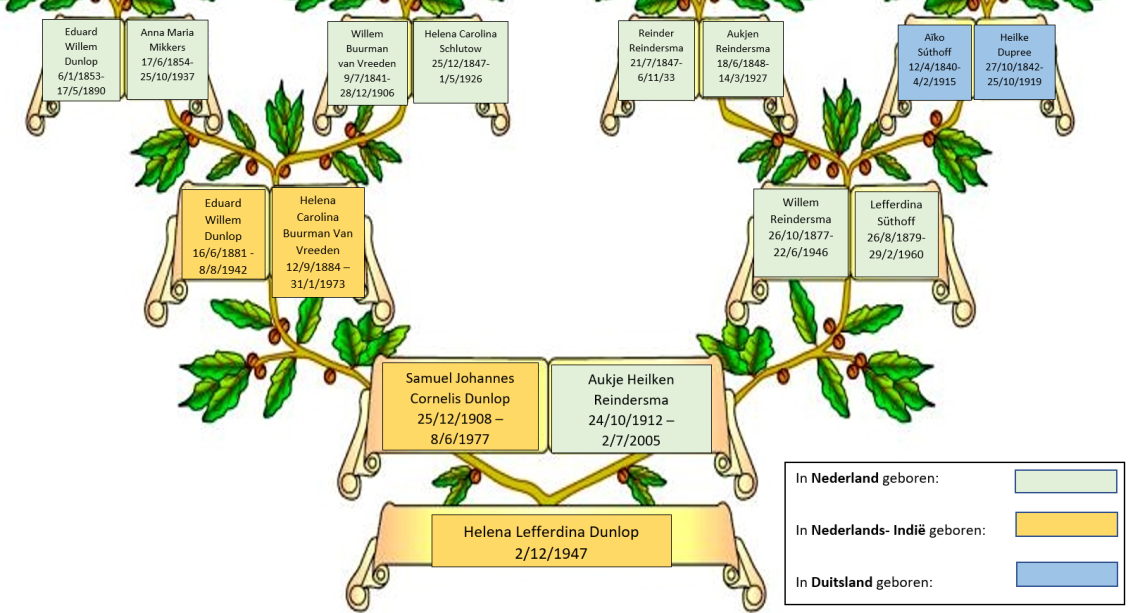
Dit artikel gaat over Hendrik Dunlop. Hendrik Dunlop werd geboren op 29 sept.1867 in Rotterdam. In 1905 trad Hendrik in het huwelijk met Emilie Viruly.
Hendrik was directeur van een distilleerderij en hij was publicist. Daarnaast heeft hij vele reizen gemaakt.
Op deze website komt Hendrik Dunlop in enkele blogs die ik geschreven heb voor:
Het artikel is geschreven door Corien Vuurman.
In 2024 ben ik een samenwerking aangegaan met Corien Vuurman, docent geschiedenis bij de lerarenopleiding van de HAN (Hogeschool Arnhem Nijmegen). Bij deze lerarenopleiding heeft mijn partner Francien Blitz tijdens haar werkend leven ook lesgegeven en via die weg heb ik Corien leren kennen.
Nádat ik Corien heb leren kennen bleek dat zij al geruime tijd bezig was met onderzoek waarbij Hendrik Dunlop, een van mijn voorouders, betrokken was.
In 2014 promoveerde zij. Haar proefschrift werd uitgegeven:
Naar aanleiding van dit boek was er een tentoonstelling en gaf Corien enige lezingen. Op deze website een mooi overzicht:
Dit blog is oorspronkelijk een artikel uit het onderstaande boek. Dit boek is een ‘festschrift’ en kwam in april 2026 uit bij uitgeverij Brill te Leiden:
This is a festschrift in honour of Arnoud Vrolijk, the emeritus curator of Oriental manuscripts and rare books at Leiden University Libraries. His title of Interpres Legati Warneriani refers to the role of keeper of the manuscripts bequeathed to the Library of the University of Leiden by Levinus Warner in 1665. The eighteen articles, ranging from book history to manuscript studies, philology and oriental art, reflect Vrolijk’s many interests and activities. Each of the contributions touches upon at least one of the fields Arnoud is interested in, has worked on, or both. All articles also deal with the collection of knowledge, and how it has been brought together, been preserved, and has been – and is being – disseminated in East and West.
Hoofdstuk 15 van dit boek is de bijdrage van Corien Vuurman.
Het artikel is geschreven in het Engels en wordt in deze oorspronkelijk taal opgenomen.
Chapter 15
Hendrik Dunlop’s Experiences and Business Activities in Qajar Persia
A Reconstruction Using (Photographic) Sources from the Family Archive and from Dutch Collections
Corien J.M. Vuurman
A nineteenth-century album with 37 photographs recently came to light in the
collection of the Print Room of Leiden University Libraries. The photographs
in this album were all taken by the already well-known Dutch entrepreneur
Albert Paulus Hermanus Hotz (1855–1930) during his journey through Persia
and the Caucasus in 1890–1891, when he paid a visit to his staff members and
trading houses and, above all when he searched for business opportunities. It
is an interesting photograph album for those who want to gain more insight
into Dutch business activities in nineteenth-century Qajar Persia, especially as
it holds photographs which experts in the field thought were only housed in
the collection of a private collector in the United States.1
In this album especially composed by Hotz, the photographs also offer a
glimpse into the life of European expatriates in Qajar Persia. They show the
various European employees of Hotz and their family members, and provide
information about the way they lived and worked, their trading houses and
the various commercial products they marketed. Persian merchants, Persian
employees and servants are also depicted. Particularly interesting is the way in
which the photographer positioned the sitters, indicating that Hotz was more
than just an amateur photographer. He must have been familiar with the way
in which artists or professional photographers created their composition for a
group portrait. For instance, we can observe in his photographs an emphasis
on a more or less hierarchical relationship or cooperation between the sitters.
And by including different objects in the image, he illustrates the status or the
daily activities of the person photographed. The handwritten subtitles by Hotz
provide information about the subjects, the names of the staff, and the loca
tions of Hotz’s trading offices: Bassorah (Basra) (Tentoon – Keddell – Fowler),
Bender Abbas (Bandar-Abbas) (Henry Marshall), Bagdad (Gale – Blockey –
Blockey junior), Bouchir (Bushehr) (v.d. Zee [H.C. van der Zee] – Groeneweg),
Shiraz (Dunlop – Muller), Isfahan (D. Collignon – J.W. Collignon – Boon –
Walley), Sultanabad (De Vries – Brown – Gale), Jezd (Yazd) (Wilton van Reede –
Prins) and Tehran (Tehran Toko).2
A certain amount has already been published about Hotz and his activities
in Qajar Persia and the photographic and other collections he left behind.3
Except for their names, however, we hardly have any information about the
staff members who lived and worked there for Hotz over several years. In this
essay, therefore, I will focus on the experiences and business activities of one
of them, Hendrik Dunlop (1867–1944), who later became something of a pub
lic figure in the Netherlands, but who has since largely faded from memory.
Originally employed by Hotz, Dunlop lived in Persia from 1890 to 1903 and later
founded a trading company together with Hotz.4 With the help of (photo
graphic) sources from the family archive and from various Dutch collections,
I will trace Dunlop’s activities in Qajar Persia in an attempt to shed more light
on Dutch trading practices in Persia in that period.
A commercial treaty between the Netherlands and Persia was concluded on
3 July 1857. It was announced in the first issue of the Staatsblad, the Dutch gov
ernment’s official gazette for the notification of new laws and regulations, of 1858
The treaty was an important agreement aimed at reviving and promoting
trade between the two countries. Dunlop included it as an appendix to his
book Perzië voorheen en thans (‘Persia, then and now’) that would be published
in 1912.5 From the moment the Suez Canal was opened in 1869, however, the
commercial and merchant shipping that had long existed between Java and
the Persian Gulf fell into decline. The Dutch consular post in the Persian port
city of Bushir (Bandar-e Būshehr), where Consul General Richard Charles
Keun van Hoogerwoerd (1838–1906) had worked for about twenty years to
protect Dutch commercial activities, was closed. However, due to continued
British interest in the trade with Persia, it was decided that a new Dutch con
sulate would be opened in Tehran.
In 1889 Fridolin Marinus Knobel (1857–1933) was appointed Dutch Consul
General in Tehran. His appointment had a favourable effect on Dutch trade
in Persia. Due to Knobel’s efforts, Dutch entrepreneurs gained more prestige
and were encouraged to do more business there. This led to the establishment
of a Dutch trading house, the so-called Tehran Toko, in 1893. As a result, more
and more European businessmen travelled to Persia for work and trade, and
Hendrik Dunlop was one of them.6 Between 1840 and 1850, only about 150
Europeans lived in Persia on an annual basis, mainly diplomats and military
personnel, but also missionaries, scientists, and adventurers. Their number
rose to about 800 in 1890 and to 1,000 around 1900. Only a very small number
of them were Dutch nationals. It is estimated that between 1840 to 1915, a total
of only about 100 Dutch people stayed in Persia for any length of time.7
In a Hotz photograph taken in Shiraz (Fig. 15.1), we see Dunlop sitting on
the left with his arms folded next to his director, I.F. Muller,8 wearing a light
coloured wide-brimmed hat and looking straight into the camera. Hendrik
Dunlop was born in the port city of Rotterdam on 29 September 1867, the sec
ond son of Samuel Dunlop and Catharina Hillegonda Dalen. The Dunlops were
a patrician family that traced back its origins to c.1753, when a merchant called
David Dunlop settled in Rotterdam. His descendants founded one branch of
the family in Amsterdam and another in the Dutch East Indies. Through inter
marriage, the Rotterdam branch of the Dunlop family was closely connected
with other prominent families in the city, including Mees, Havelaar, and van
der Hoop.
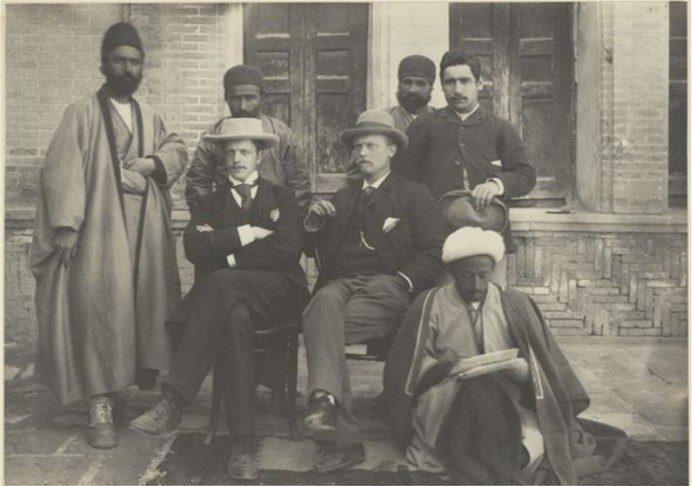
Leiden University Library, Print Room, A. Hotz album [UBL PK-F-73.151 –
photo 22
Representing, together with his brother David (b. 1864), the sixth genera
tion of Dunlops, Hendrik received his secondary education at the Higher Civic
School (Hogereburgerschool, HBS) in Rotterdam. This was a practically oriented
educational establishment for higher functions in industry and trade, and he
was already determined to become an important businessman.9 Dunlop
started his career at the age of 21, when he joined J.C.P. Hotz & Son.10 He had
met Hotz in 1898 at the Vereniging Neerlandia, the ‘Dutch Club’ in London, a
meeting place for young Dutchmen to develop personal friendships and meet
businessmen in a relaxed atmosphere, allowing them to lay the foundation for
their future careers.11 One year later, on 2 April 1890, he set off for Persia on
behalf of Hotz, travelling from the Netherlands (he had collected his passport
in The Hague on 14 March 1890), overland via Berlin, Moscow and from there
to Baku, Enzeli and Resht, finally arriving in Tehran on 27 April. From there he
continued his journey to Isfahan and Shiraz.12
Dunlop’s letters to the Cambridge Orientalist Edward Granville Browne
(1862–1926) from 1896 and 1897 confirm that he had lived in Shiraz for about
six years by then, revealing that he intended to move to Tehran.13 It is not
entirely clear when he actually did move to the Persian capital. However, in
one photograph, taken in 1899, he stands in front of his house in Tehran with
some Persian merchants as well as three Europeans, one of whom can be iden
tified as Albert Houtum-Schindler (1846–1916), the Director of Persia’s Foreign
Office Control Department, who acted as general adviser to the Persian
Government (Fig. 15.2).14
Dunlop travelled extensively for his work in Persia and Iraq.15 Like everyone
else – Persians and foreigners alike – Dunlop needed official travel passes, at
least one of which is still preserved in the Dunlop family archives. An accom
panying letter dated 1 June 1897 from a police station in Baghdad and written
In 1899: Voor de pui van mijn huis te Teheran in den zomer, vermoedelijk.
Europeanen, van links naar rechts: A. Houtum Schindler, employé, P.P. ter
Meulen, employé, F.W. Emmerson, employé (per procuratie), H. Dunlop
in Arabic, states that all police stations on the way from Baghdad to Iran were
to look after Dunlop and provide him with protection.16
Dunlop’s manuscript travel diary contains a passage in which he wrote
that he had become his own boss. He wrote that he was happy that from that
moment on he no longer had to ride those miserable post horses, but could
ride his own good horse Edgar, and that he had his own caravan consisting of
six mules, his white greyhound Hector, and his servants Hassan and his brother.
Intriguingly, these lines were written while travelling from Bushir to Shiraz on
12 November 1890, mere months after Dunlop’s arrival in Persia.17 The date
cannot be correct – the abundant references to his director, Muller, testify to
this – but the sentiment may fit in with a development nine years later. On
25 October 1899 the Dutch daily newspaper Algemeen Handelsblad announced
that Dunlop had entered into a partnership with Hotz and Willem Groeneweg.
At the time Hotz resided in London, Groeneweg in Constantinople, and
Dunlop in Tehran. The company of Groeneweg, Dunlop & Co. was established
for the purpose of conducting general commercial business and representing
agencies, insurance companies, banks and trading houses.18
Another interesting photograph album is housed in the collections of the
Rijksmuseum in Amsterdam. It is Dunlop’s travel album. As far as we know,
Dunlop did not take any photographs himself, but he collected images dur
ing his travels to several countries and during his stay in Persia, at least in
the period between 1890 and 1895. In his album we find 62 photographs 43
of which were taken in Persia by the well-known professional photographer
Antoin Sevruguin (1851–1933).19 The remaining photographs, purchased from
other professional photographers during his travels, show interesting sights he
visited in Germany and Russia, while he was on his way to Persia, and in China,
Scotland, and Canada.20 As we examine the Persian photographs in his album,
we discover Dunlop’s interest in themes that can also be found in his writings,
such as landscapes, (ancient) monuments, cityscapes, travellers, Persians and
dervishes, bridges and rivers, roads and telegraph poles. In his travel diary he
recorded his daily experiences during his trip. He informs us about the times of
departure and arrival, weather conditions, the landscape and travel route, the
villages, cities and the post- or guesthouses, the horses, the meals, the people
he met and the (ancient) monuments he saw.
Dunlop’s notes are a valuable source on travel in Persia towards the end of
the nineteenth century. His diary shows that he rode on horseback from one
post house, caravanserai or telegraph station to the next. Roads were usually
bad, full of holes or rocky. Since rooms were not always available, he and his
travelling companions were occasionally forced to sleep on the roof or to con
tinue their journey and ride through the night to the next station. After sunset
they had to use torches or candles to find their way. This was quite a dangerous
endeavour because they did not know the roads well. Horse riding was espe
cially dangerous in the mountain areas. In lower areas rivers which they then
had to ford often overflowed their banks. There were not always enough post
horses to rent, so that so now and then the journey had to be postponed. Most
horses were in poor condition and fell regularly. On one occasion, Dunlop som
ersaulted over his horse’s head, fell into a river and was completely soaked.
Fortunately, he did not break anything himself, but one of his fellow travellers
fractured a collarbone. A major problem during his journey was that there was
not always enough food or water in the villages. The water was sometimes pol
luted or too salty to drink.
In addition to information about travelling, his notes also contain valuable
information about the context of the photographs Dunlop collected. With
the help of his notes some of his photographs can be described better and
more fully. This is especially true of those elements that cannot be seen in a
photograph, such as smells and sounds; the personal character of Persians he
met along the way; the temperature; and the sulphurous taste of the water
of the Daliki River, near which Europeans had placed derricks to find oil.21
Noticeably absent from Dunlop’s travel notes are reflections on current events
and developments in Persia at the time – but his later publications show that
he was interested in them nonetheless.
It is not surprising that the themes in Dunlop’s photograph album are more
or less similar to those found in the Hotz albums. Dunlop, like Hotz, belonged
to the higher classes in society in which erudition was highly valued, also in
merchants. He was therefore not only involved in trade, but also showed an
interest in (ancient) history and the culture of Persia.22 This is particularly well
illustrated in Dunlop’s book Perzië Voorheen en Thans, in which he provides an
overview of the history of the Persian Empire and in which he also pays ample
attention to the time of the Qajars (1779–1925).23 His comments on the various
events in the Persia of his time and the appendices with political, commercial
and economic information were closely linked to Dunlop’s business interests.
In the introduction to his book, however, he says that the motivation for writ
ing his book was that, after living in Persia for many years, he had become curi
ous about its history. He had noticed many contradictory things in this country
and had also discovered remnants of the past. For these reasons, he wanted to
inform the general public about the great diversity of Persian culture. His book
contains many photographs, most of which were taken by Sevruguin.24
Another publication that Dunlop compiled with the help of the sources col
lected by Hotz is a collection of Dutch archival sources on the history of the
Dutch East India Company (VOC) in Persia. First established there in 1623, for
more than a century, the Dutch East India Company had one of its most impor
tant branches in mainland Asia and Persia. For both Hotz and Dunlop, the
Company was not only an interesting example of Dutch trade in the East, but
it also demonstrated the age-old Dutch ties with Persia that were so important
for the continuation of their activities there.25 In Isfahan’s Armenian quarter
of New Julfa (established in 1606), Hotz took photographs of the tombstones
of the employees of the Dutch East India Company. Dunlop copied the names
on these tombstones and included them in his travelogue.26
At the end of Dunlop’s photograph album a remarkable picture (Fig. 15.3) –
photographer unknown, taken at “Bushira, Perzische Golf, Mei 1987” – shows
a Western interior (with a table, chairs, and a cupboard) in which three white
men in Western clothing are sitting at a rectangular set table, raising their glass
in a toast. The subtitle of this picture provides us with three names of European
expatriates in Persia, from left to right: F.W. Emmerson (who also figures in
the photograph mentioned above with Houtum-Schindler), H.C. van der Zee,
and H. van Pouderoyen, all three of whom worked for Dunlop in Bushir. In his
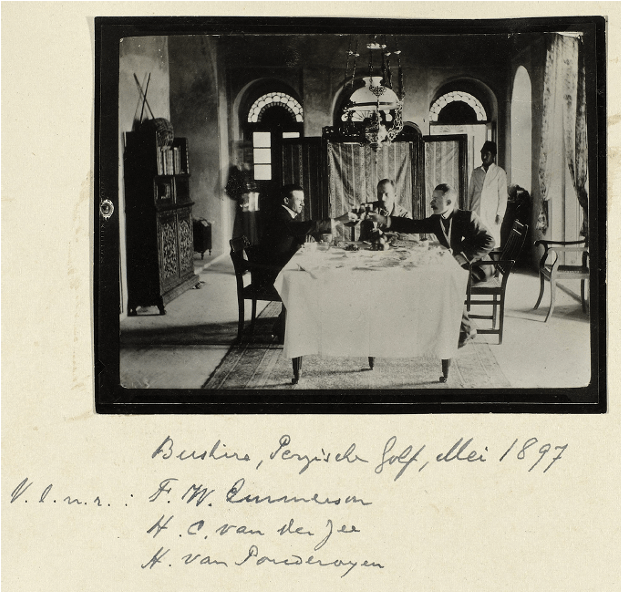
H. Dunlop, travel album, photographer unknown. Subtitle: Bushire, Perzische
Golf, mei 1897. V.l.n.r. F.W. Emmerson, H.C. van der Zee, H. van Pouderoijen /
Bushire, Persian Gulf, May 1897. From left to right. F.W. Emmerson, H.C. van
der Zee, H. van Pouderoijen, developing gelatin silver print, 10.8 × 8.5 cm
[Rijksmuseum Amsterdam, RP-F-F01048-BJ
travel diary Dunlop writes that he visited Van der Zee at the office in Bushir
on 11 May 1890. He characterizes him as a middle-class man, not unpleasant,
tall, blond, and very strong, but who spoke the beautiful Persian language very
poorly, just like Muller in Shiraz, who pronounced the Persian word for ‘water’
(âb) like the Dutch word aap (monkey) – something which Dunlop ridiculed.27
Dunlop arrived in Shiraz on 1 June 1890 and first went to visit the house of
his director, Muller. Muller was also not bad as far as Dunlop was concerned
and was a man from the middle class. He owned a white horse that he rode
every day and wore trousers that were very wide at the bottom.28 Dunlop notes
that the office in Shiraz was housed inside a caravanserai named ‘Karavansera
Amir’ and that the bazar was very nice, high and cool. Several guilds were
represented in the bazaar. Hotz’s sales office sold mainly cotton goods, such
as the Turkish-red twills and prints sourced from F. Steiner & Co dye works
in Lancashire, as well as many bleached and grey shirting from the company
H.J. van Heek & Sons in Enschede and also shirting from Jansen & Tilanus in
Friezenveen.29 Van Heek’s correspondence with the trading houses in Persia is
kept in the city archives in Zwolle. The archive also provides insight into the
accounting, such as orders and the prices of the different cotton goods. There
are also some cotton samples.30
In his book, Dunlop noted that Persia in his day was awash with foreign
cheap cotton, which he considered a sad product of modern bad taste. In his
opinion, mass production destroyed the domestic textile industry, while the
arts and crafts in Persia were also in decline. According to Dunlop, the gov
ernment would do well to encourage craftsmen again to produce products
of quality.31 Willem Floor confirms that in the course of the nineteenth cen
tury most of Persia’s domestic textile industry disappeared because it could
not compete with cheap Indian and European imports. It was not until the
1920s that the domestic textile manufacturing received government protection
through tariffs and non-tariff barriers.32
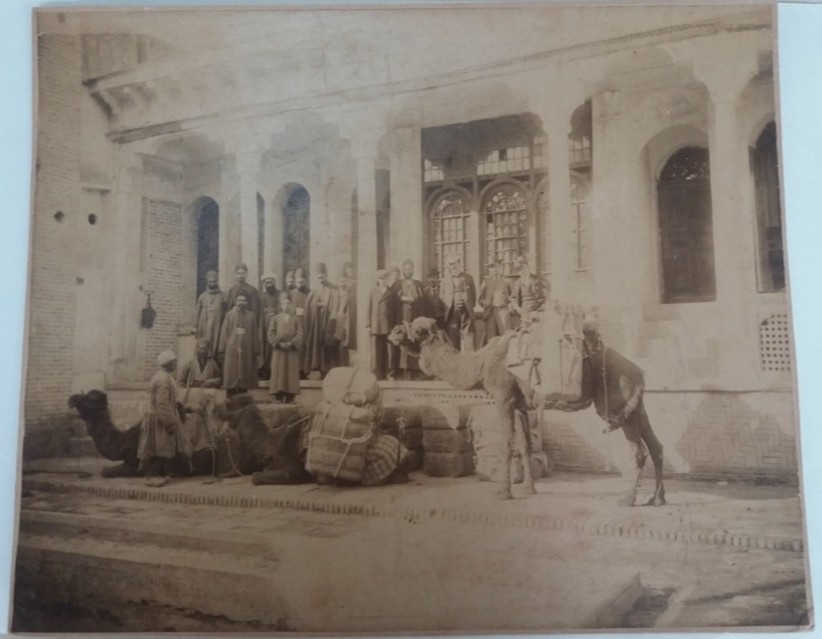
Nine photographs of Dunlop’s (business) activities in Persia and one
in Constantinople can also be found in his family archive in the Rotterdam
City Archives. It is not known who took these photographs. The images show
Dunlop in or at the front of his house or his office in Shiraz with various other
Photographer unknown, subtitle: Het huis met binnenplaats te Shiraz,
waarin ons kantoor en verpakkingen waren ± 1892. De drie Europeanen
(van l naar r) zijn: H. Dunlop, Alex Houtum Schindler en F.W. Emmerson.
/ The house with courtyard in Shiraz, where our office and packaging
were ± 1892. The three Europeans (from l to r) are: H. Dunlop. Alex
Houtum Schindler and F.W. Emmerson. Albumen print, 27.4 × 22.5 cm
[RCA, 400 Dunop Family Archives, No. 248]
European and Persian business men, his director, Muller, and Persian employ
ees, with different kinds of merchandise, camels, his horse Edgar and his grey
hound Hector (Fig. 15.4).33
During his first trip, Dunlop met several Europeans. They gave him different
pieces of advice about travel and business, travelled with him every now and
then, invited him to dinner, and offered him entertainment or hospitality in
their houses. Important people in Persia who helped him further explore his
business opportunities included the aforementioned consul Fridolin Knobel,
the chief executive of the Imperial Bank of Persia, Joseph Rabino, and Albert
Houtum-Schindler. Rabino introduced Dunlop in Tehran to the so-called
‘Cercle des Européens’. Dunlop writes that Rabino was of Jewish descent – he
was born in London to an Italian Jewish family – and was cross-eyed. He and
Schindler were, according to Dunlop, very friendly and spoke fluent English.
Van Houtum-Schindler, according to Dunlop, looked like a Dutchman and also
spoke a little Dutch. During a dinner at his home he informed Dunlop about
the various projects of the Imperial Bank such as the construction of roads and
mines, and the irrigation of the Karun River in southwestern Iran.34
During his many years of residence in Shiraz, Dunlop was also part of a cir
cle of European expatriates. In one photograph of Dunlop’s tennis club we see
how comfortable these expatriates felt together. They portrayed themselves as
one big family. Being far from home, it was certainly important for them to
hold on to their values, norms and traditions. This also applies to their sports
activities (Fig. 15.5).
Regarding Dunlop’s interest in (ancient) monuments, the photograph taken
in 1892 on which Dunlop poses in front of the Bagh-i Takht (Fig. 15.6), while
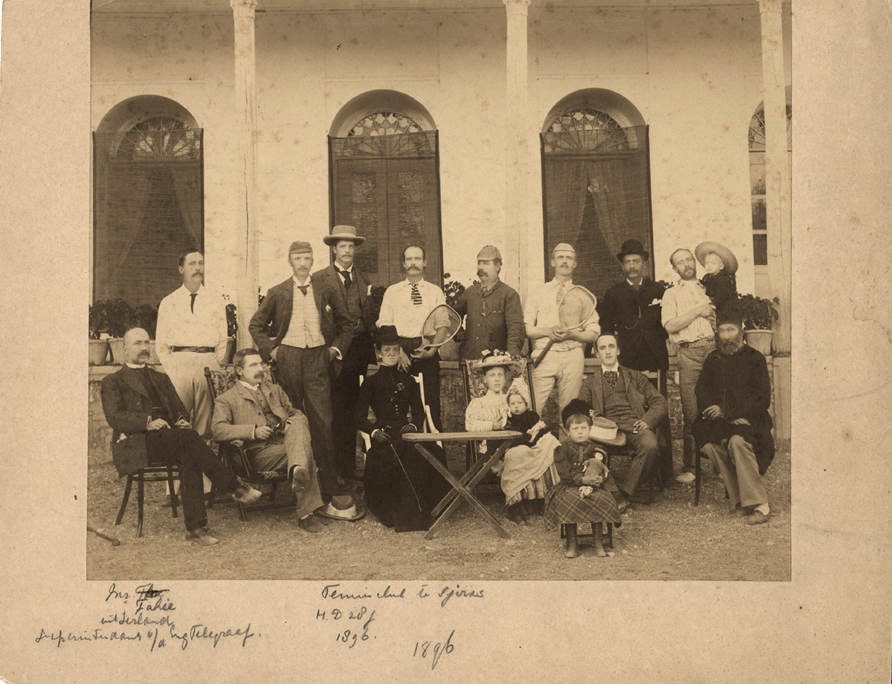
Photographer unknown, subtitle: Tennisclub te Sjiraz. H.D. 28 j. 1896. Ir. Fahie
uit Ierland, superintendant v/d Eng. Telegraaf. / Tennis club in Shiraz. H.D. 28 y.
Ir. Fahie from Ireland, superintendent of the Eng. Telegraph. At the back of
the photograph: Shiraz 1896. H.D. oud 28 jaar. / Shiraz 1896. H.D. 28 years old.
Albumen print, 23 × 19 cm [RCA, 400 Dunlop Family Archives, No. 248]
sitting on his horse Edgar together with a gentleman, “Cornelis from Deli”, who
paid him a visit, is interesting. Bagh-i Takht is located on a rocky hillside north
of Shiraz that existed as early as the eleventh century. It is a garden with a
central water channel and laid out on multiple terraces with a palace at the
uppermost terrace. Travellers through the ages have been impressed by it.35
Dunlop also refers in his travel diary to other ancient monuments in the
environment of Shiraz, such as Pasargadae and Persepolis. He arrived in
Persepolis on 1 June 1890 towards sunset and was impressed by the majestic
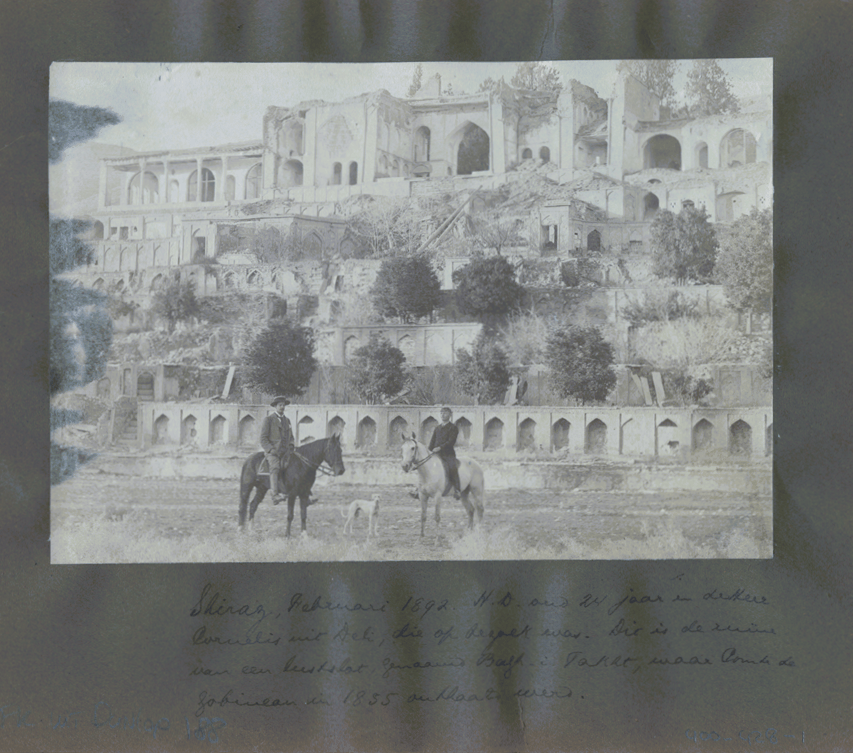
Photographer unknown, subtitle: Shiraz, Februari 1892. H.D. oud 24 jaar en
de heer Cornelis uit Deli, die op bezoek was. Dit is de ruïne van een lustslot
genaamd Bagh-i Takht, waar Comte de Gobineau in 1855 onthaald werd. /
Shiraz, February 1892. H.D. old 24 years and Mr Cornelis from Deli, who was
visiting. These are the ruins of a pleasure castle called Bah-I Takht, where
Comte de Gobineau was entertained in 1855. Albumen print, 21.4 × 14.9 cm
[RCA, 400 Dunlop Family Archives, No. 248]
ancient palace complex. While climbing the entrance stairs to the platform, his
horse fell and became paralyzed. The things he notes about the Achaemenid
palace complex can also be found in travel reports by other writers, for exam
ple that the ruin reminds him of Omar Khayam’s lines of poetry. He notices
the cuneiform writing and graffiti of travellers such as that of the famous
British-American explorer, Henry Morton Stanley (1841–1909), and of Cornelis
de Bruijn (1652–1727), the Dutch artist who was the first European to make
reliable drawings of Persepolis.36 Dunlop also learned the basics of cuneiform
script – a knowledge he later passed on to the Persian poet, scholar and artist,
Mīrzā Moḥammad-Naṣīr (or Naṣīr-al-Dīn) Ḥosaynī Shīrāzī, also known as
Mīrzā Āqā and Mīrzā-ye Forṣat, who used the pen-name of Forṣat al-Dawla.37
Being involved in business also brought Dunlop into contact with Persian
merchants. A special photograph is that of Dunlop and his director Muller
standing in front of the house of the old merchant Hadji Mirza Seyyed Hasan
(1807–1892), or Afnán-i-Kabír (the Great Afnán) as he was known amongst
Baháʾis, here surrounded by his five sons (Fig. 15.7).
According to De Vries, this is the first Dutch portrait of Baháʾis, Dunlop hav
ing met several Bábís during his stay in Shiraz. In Tehran he acquired several
manuscripts of religious writings by the Bábi and Baháʾí, which he offered for
sale in 1896 to E.G. Browne. Because a transaction never materialized, Dunlop
then offered the manuscripts for free to Michael Jan De Goeje (1836–1909), the
Professor of Arabic at Leiden University.38 Not much is known about Dunlop’s
personal experiences with Bábís in Shiraz or Tehran, but by writing about this
religious sect he was one of the first to spread knowledge about the Baháʾí reli
gion in the Netherlands.39
At the beginning of 1902 Willem Groeneweg withdrew from the firm of
Groeneweg, Dunlop & Co., because in his opinion the business had no future.
The firm of J.C.P. Hotz & Son in London suffered significant losses in the next
year. The resulting bankruptcy dragged the other branches in Persia along with
it. Deferment of payments also had to be requested for Dunlop & Co.40 The
correspondence in the business archives of Van Heek illustrates the shock this
bankruptcy caused in the Netherlands. It was also extensively reported in vari
ous Dutch newspapers. Dunlop eventually had nothing left and had to return
to the Netherlands. Archival bank statements and the eulogy by his only child,
David, confirm that Hendrik Dunlop came home bankrupt. His son David
concluded that, in financial terms, the whole Persian adventure had yielded
his father nothing.41
After his return to the Netherlands, Hendrik Dunlop first started working in
the family’s distillery. On 9 March 1905 he married Emilie Viruly (1879–1946).
Their son, David, was born on 21 December of the same year. Once again,
Dunlop was successful in business, while also becoming a public figure due to
his many publications about international relations, current affairs, and eco
nomic developments. Among his correspondents we find the names of Dutch
scholars such as the Orientalists Christian Snouck Hurgronje and Michael Jan
de Goeje; scientists like the physicists Hendrik Lorentz and Heike Kamerlingh
Onnes; as well as Dutch literary figures such as Louis Couperus and Albert
Verwey. Some of his works were also published in English,42 which might
explain why a letter from Sir Arthur Conan Doyle is also to be found among
the Dunlop correspondence. The fact that he eventually overcame his financial
troubles is illustrated by his purchase of the Loevesteyn estate in Wassenaar,
a stately mansion on almost 10 acres of land.43 He died on 21 February 1944.44
De lijst met noten die in het oorspronkelijke artikel onder aan de bladzijden te vinden waren:
- Leiden University Libraries, Print Room, Hotz-Album (UBL PK-F-73.151) counts 37 photo graphs, titled Aangeboden ter gedachtenis aan mijne reis in 1891 (‘Presented in memory of my journey in 1891’). The Hotz-album in the Elmar Seibel collection (Ars Libri. Boston, MA) counts 45 photographs. It is titled Aangeboden ter gedachtenis aan mijne reis in 1891. Kantoren en personeel in Perzië van de firma J.C.P. Hotz en Zoon en de Teheran Toko (‘Presented in memory of my journey in 1891. Offices and staff in Persia of the company J.C.P. Hotz and Son and the Tehran Toko’) The subtitles are written by Hotz in Dutch. The photographs taken in Jezd (Yazd) and those of the Tehran Toko are missing from the Leiden University Libraries album. These photographs are albumen prints (and not platinum prints like the entire collection of photographs taken by Hotz) and may have been taken by another photographer. It is noteworthy that Hotz did not visit Jezd during his trip
- Ibidem. See also Leiden University Libraries (BPL 2404 – July–Dec 1889 H–J, 39th folder, nos. 1467–1489); a letter dated November, 18, 1889, to the curator of the National Ethno graphic Museum in Leiden, Johannes Dietrich Eduard Schmeltz (1839–1909), written by Hotz (J.C.P. Hotz & Son) for Hotz’s various trading offices and the names of its staff: ‘A. Brown (Sul tanabad), I.H. Collignon (Isfahan), W. Groeneweg (Bushire), I.F. Muller (Shiraz), Joh. F.B. Rolufs (Bussorah)’. Leiden University Libraries, Special collections: In Hotz’s photo album 5, we also find photographs of M. Ferguson and H.W. Maclean (no. 10, Isfahan), Mr. and Mrs. Charnaud (no. 25, Bagdad).
- See for example: Vuurman en Martens (1995), Engelberts (1995/1999 en 2000), Witkam (1998), Vuurman (2011), en Vuurman (2013).
- Dunlop (1912: 412).
- Dunlop (1912: 575ff).
- Vuurman (2011: 27) and Leiden University Libraries, Collection Leeuwenburgh (Or. 25.616) contains 11 photographs of the so-called ‘Tehran Toko’. These photographs, probably taken by Antoin Sevruguin, show the outside and the interior of the building.
- De Vries (2002: 20).
- In Dunlop’s travel diary, his director’s name is occasionally written as Müller. Hotz also notes Muller and Müller
- The Rotterdam City Archives (RCA), 400 Dunlop Family Archives, No. 244: Hendrik Dunlop’s date of birth is registered in the Birth Registers of the Municipality of Rotterdam. Also see the eulogy by his son David Dunlop in RCA, 400 Dunlop Family Archives, No. 265
- RCA – 400 Dunlop Family Archives, No. 248: Dunlop’s travel diary, page 1.
- Engelberts (2000, 41ff).
- Dunlop’s travel diary, page 1ff. Dunlop travelled by train from Rotterdam to Berlin, Moscow, Tsaritsyn (Wolgograd/Stalingrad), then by boat to Astrachan, and finally to Enzeli. From here he rode on horseback to Resht, Manjil, Kasvin and Tehran. Dunlop recorded his daily travel experiences in a large notebook. The collection also includes a small notebook in which Dunlop summarized his daily travel experiences and also included some other information. According to his travel diary, Dunlop left Shiraz for Europe on 12 December 1894, arriving in Rotterdam on 22 January 1895. On 8 October 1895 he returned to Shiraz, arriving there on 12 December 1895. In 1899, he returned to the Netherlands permanently
- Cambridge University Library, E.G. Browne Collection, Letters from Dunlop to Browne dated 9 October 1896 and 2 January 1897. Browne and Dunlop had not met in Persia, the former already having returned to England in 1888. In his travel diary (p. 36), among his notes from the year 1890, Dunlop included a passage about 13 May 1891, stating that he left Shiraz to travel to Tehran to open an office there and that he had sold all his belongings. After this passage he continued with the year 1890. It is therefore not entirely clear when exactly he left for Tehran.
- I am grateful to Heldine Dunlop for showing me this photograph from her family collection. For E.G. Browne’s biographical sketch of Houtum-Schindler, see Edward G. Browne, “The Persian manuscripts of the late Sir Albert Houtum-Schindler, K.C.I.E”, Journal of the Royal Asiatic Society 49/4 (1917): 657–694. For a more recent scholarly discussion, see Houtum-Schindler: John D. Gurney, ‘Houtum-Schindler, Albert’, Encyclopaedia Iranica, XII/5, pp. 540–543, http://www.iranicaonline.org/articles/houtum-schindler-albert (accessed on 30 December 2012): Albert Houtum-Schindler was an authority on Persia, an engineer and employee of the Persian government for over thirty years in the later 19th and early 20th centuries. Some sources suggest that he was Dutch and was born in the Netherlands, but it was generally assumed that he was German.
- Dunlop (1912: 8).
- The RCA – 400 Dunlop Family Archives: The Arabic document bears a stamp and a sig nature of the relevant police station. It is remarkable that Dunlop should be mentioned here as an English citizen. I am grateful to Dr. Reza Sheikh and Dr. Nader Sohrabi for the translation of this document.
- Dunlop’s travel diary, p. 42f. ‘Daar ik thans mijn eigen baas ben geworden, behoef ik niet meer die ellendige postpaarden te berijden, maar berijd mijn eigen goede paard Edgar, en mijn karavaan bestaat uit 6 muildieren en de hazewind hond (wit) Hector. Mijn bedienden zijn Hassan en zijn broeder.
- For more detailed information, see the memorandum of association of this com pany in RCA – 400 Dunlop Family Archives, no. 259: Firmacontract tussen A.P.H. Hotz, W. Groeneweg en H. Dunlop, gepasseerd voor notaris Pollones te Amsterdam, 14 Sept. 1899. Also see https://www.delpher.nl – Algemeen Handelsblad, 25 October 1899, page 3.
- For Sevruguin: see Bohrer (1999).
- Rijksmuseum Amsterdam (RP-F-F01048) Travel album. Title ‘H. Dunlop Shiraz, Perzië, 1890–1895’. The places in Persia mainly concern: Tehran, Shiraz, Isfahan, Bushehr, Kasvin, Kazerun, Pasargadae and Persepolis. Dunlop’s travel diary, page 7 – Dunlop writes that he bought photographs in Moscow
- Dunlop’s travel diary, p. 43f. On 12 November 1890, Dunlop arrived at the derricks in Daliki. He met the Austrian engineer Kmentt who had recently started drilling with new workers. In other sources, he is referred to as “Captain Kmentt”; see British Library, India Office Records and Private Papers, Mss Eur F111/71: Correspondence, Printed Papers and Newspaper Cuttings Relating to the Persian Bank Mining Rights Corporation Ltd (581/586): The Persian Bank Mining Rights Corporation, Circular to the Shareholders, 24 April, 1891, f. 269r. The document mentions that the Corporation had acquired the mining rights to the Daliki petroleum fields “originally conceded to the firm of Messrs. Hotz”. Kmentt’s employees could not cope with the work, were lazy and drunk. After a tour of the work area and drinking tea, Dunlop swam in the Daliki River with Kmentt. Vuurman (2011: 309) In the early eighties of the nineteenth century Hotz acquired a small oil concession in Daliki (forty miles north-east of Bushehr). Hotz took photographs of a derrick in the petroleum camp in Daliki. See Hotz album 1, photo no. 60 and 61 and album 9, photo no. 59 and 60.
- Rijksmuseum Amsterdam (RP-F-F01048) Travel album. Title ‘H. Dunlop Shiraz, Perzië, 1890–1895’. The photographed places in Persia in this album mainly concern: Tehran, Shiraz, Isfahan, Bushehr, Kasvin, Kazerun, Pasargadae and Persepolis
- https://www.delpher.nl: Dunlop’s book is announced in Algemeen Handelsblad, 25 Nov ember 1912, p. 12.
- Dunlop (1912: 37ff) shares that he has made the journey from Bushir to Shiraz several times. He visited several ancient monuments likes Persepolis and Pasargadae.
- Engelberts (2000: 86f and 102) See: Bronnen tot de Geschiedenis der Oostindische Compag nie in Perzië, No. 72, Vol. I (1611–1638), XCVII, 850 p. In 1906 Hotz was commissioned by the Minister of Education to compile this source publication. In 1926, toward the end of his life, he handed over the task to Dunlop.
- Leiden University Libraries: Hotz album 2, no. 62. Dunlop’s travel diary, p. 30. Dunlop (1912: 571ff) included Shah Abbas’ treaty with the Dutch East India Company in his book (Translated into Dutch by the government)
- Dunlop’s travel diary, p. 42 ‘Arr. Bushire 8 ure ’s-morgens. Van der Zee is op kantoor, ga met hem naar zijn huis. Hij is niet kwaad, groot en blond, zeer sterk, en een burgerman, die de mooie Pers. taal zeer slecht uitspreekt, evenals Müller te Shiraz, die âb (= water) uitsprak: ‘aap’. Quel imbécile!
- Photographs of Muller and his house in Shiraz can be found in Leiden Library Universi ties, Hotz Collection, Hotz photo album 1, no. 10 and 11a and photo album 9, no. 80 and 81a. A photo of Van der Zee in Hotz-Album (UBL PK-F-73.151), photo 2.
- Dunlop’s travel diary p. 35f.
- ANNO City Museum Zwolle. Archive of the Company Van Heek & Co 1817–1968 (1979) and the N.V. Boekelosche Stoombleekerij 1888–1965, file 1467–1473 (concerning Turkey) and file 1483–1489 (concerning Persia). For an inventory of the archive see: http://www2 .historischcentrumoverijssel.nl/overijssel/inventarissen/vanheek/166i.htm.
- Dunlop (1912: 29).
- Floor (July, 20, 2005) for more information on the textile industry in Iran (Acta Iranica) – TEXTILE INDUSTRY IN IRAN – Encyclopaedia Iranica (iranicaonline.org): https://www .iranicaonline.org/articles/textile-industry-in-iran/
- The RCA – 400 Dunlop Family Archives, No. 248: Loose photographs, photographers unknown. Photo 1. Subtitle: Shiraz, Perzië, april 1891, H.D. oud 23 jaar, met breedgeran den hoed, tegen den muur geleund. Staande de heer Muller, mijn chef. Het huis is dat van Hadji Mirza Hassan, een oud koopman, zittend, Om hem heen zijne vijf zonen. Albumen print 21. × 15.4 cm. Photo 2. Subtitle: Mijn kamer in mijn woonhuis te Shiraz. Staande: Mohamed Kerim, vrije manager, c.1890–1891. Albumen print, 29 × 23.9 cm. Photo 3. Subtitle: Het huis met binnenplaats te Shiraz, waarin ons kantoor en verpakkin gen waren ± 1892. De drie Europeanen (van l naar r) zijn: H. Dunlop, Alex [sic] Houtum Schindler en F.W. Emmerson. Albumen print, 27.4 × 22.5 cm. Photo 4. Subtitle: Shiraz, Februari 1892. H.D. oud 24 jaar en de heer Cornelis uit Deli, die op bezoek was. Dit is de ruïne van een lustslot genaamd Bagh-i Takht, waar Comte de Gobineau in 1855 onthaald werd. Albumen print, 21.4 × 14.9 cm. Photo 5. Subtitle: H. Dunlop, Shiraz, Dec. 1893. Albumen print, 16.6 × 21.4 cm. Photo 6. Subtitle: Mijn huis te Shiraz. 1894/26 j. Mohammed Kerim (Makelaar) Paard: Edgar. Albumen print, 24 × 19.8 cm. Photo 7. Subtitle: April 1894 (portrait of Dunlop). Albumen print, 7 × 9.8 cm. Photo 8. Subtitle: Tennisclub te Sjiraz. H.D. 28 j. 1896. Ir. Fahie uit Ierland, superintendant v/d Eng. Telegraaf. At the back of the photograph: Shiraz 1896. H.D. oud 28 jaar. Albumen print, 23 × 19 cm. Photo 9. Subtitle: H.D. met Schindler in het wagentje met het paard genaamd Jumbo (een zeer slim paard) op het groote plein te Teheran, 1900(?). Pink albumen print, 8.6 × 7.2 cm. Photo 10. Subtitle: Constantinopel 20 juli 1901. Van Links naar rechts. Le Marez Oyens Jur. Cand., Huber (later vice consul te Melbourne), Von Zeppelin Obermüller (staande) (later consul der Ned. te Shanghai en in Brazilië), Dunlop (33 jaar), Müller, Rueb (later bij Jacobson, Vd Berg + Co, Batavia), Cauvée. Albumen print, 28.5 × 21.1 cm.
- Dunlop’s travel diary, 28 April 1890, p. 21ff. Abbas Amanat, GREAT BRITAIN iii. British influ ence in Persia in the 19th century: https://www.iranicaonline.org/articles/great-britain -iii/ Originally Published: 15 December 2002. Last Updated: 23 February 2012, The estab lishment of the Imperial Bank of Persia in January 1889 has to be seen as Britain’s crown ing achievement and its most effective economic tool in penetrating the Persian markets. Under Joseph Rabino, its energetic director and Reuter representative in Tehran, the Bank grew from eight branches in Persia in 1890 to 17 in 1920.
- See htpps://www.archenet.org for more information on this site. In the nineteenth cen tury, it was referred to as ‘Takht-i Qajar’. It was only after 1850 that the garden became known as the Bagh-i Takht. In the early nineteenth century it was revealed that the foun dation of the palace was dated 1789 and was attributed to the Qajar ruler Muhammad Shah (1796–1797). The construction of the Bagh-i Takht has also been attributed to Fath Ali Shah (1797–1834), the nephew and successor of Muhammad Shah.
- Dunlop’s travel diary p. 34ff: Dunlop also visited Persepolis on 23 November 1890, where he stayed for two or three hours. Dunlop arrived on 31 May and 26 November 1890 in Pasargadae. He carried the book of Malcolm, Sketches of Persia: From the Journals of a Traveller in the East’, Vol. 1 and 2, 1827, with him. See also Vuurman (2015: 106f).
- Manouchehr Kasheff, “Forṣat al-Dawla”, Encyclopaedia Iranica Online, originally pub lished: 15 December 1999, last updated 31 January 2012.
- At least one of Dunlop’s manuscripts is still preserved in the Leiden University Libraries, Cod. Or. 4970, a collective volume with texts in Arabic and Persian that includes the Javāhir al-asrār fi maʿārij al-afsār, a Bābī scripture in Persian and Arabic. The provenance is recorded as: “Received on October 4, 1898, as gift from Hendrik Dunlop (*1867) in Tehran.”
- De Vries (2002: 37ff) states that Dunlop stayed in Shiraz until 1897 and that he then moved to Tehran. He also claims that Hotz took this photograph. Dunlop (1912: 327ff).
- Engelberts (2000: 79), and https://www.delpher.nl – Algemeen Handelsblad, page 2, 17 March 1902 – for an announcement that Groeneweg had left the company. The RCA – 400 Dunlop Family Archives, no. 260: Documents regarding the liquidation of the company.
- ANNO City Museum Zwolle. Archive of the Company Van Heek & Co 1817–1968 (1979) and the N.V. Boekelosche Stoombleekerij 1888–1965, file 1467–1473 (concerning Turkey) and file 1483–1489 (concerning Persia). It started with the suicide of a Hotz employee in London who had embezzled funds from the company. Van Heek went to Constantinople to claim his cotton. The Ottoman government had seized these goods. See for further information https://www.delpher.nl – Dagblad van Noord-Brabant, 5 June 1903 and Haarlem’s Dagblad, 3 June 1903.
- E.g., Hendrik Dunlop, The Supreme Will or the Danger of a Premature Peace, published January, 1916 by Springer Science Business Media BV. The RCA – 400 Dunlop Family Archives, No. 254. The RCA – 400 Dunlop Family Archives, No. 265: David’s eulogy.
- The RCA – 400 Dunlop Family Archives, No. 254.
- The RCA – 400 Dunlop Family Archives, No. 265: David’s eulogy
Bibliography
Bohrer, Frederick N., Sevruguin and the Persian image: photographs of Iran, 1870–1930
(Arthur M. Sackler Gallery, Smithsonian Institution, University of Washington
Press, 1999).
Dunlop, H., Perzië Voorheen en Thans (Persia before and now) (Haarlem: De Erven F. Bohn, 1912).
Dunlop, H., Bronnen tot de Geschiedenis der Oostindische Compagnie in Perzië, nr.
72, Vol. I (1611–1638) XCVII, Rijks geschiedkundige publicatiën (’s-Gravenhage:
Martinus Nijhoff, 1930).
Wagenvoort, Maurits, Karavaanreis door Zuid-Perzië (Santpoort, C.A. Mees, 1926).
Engelberts, T.H.E., Een Pers uit een vreemd land. Levensschets van Albertus Paulus
Hermanus Hotz (Den Haag: Enroprint B.V., 1995, 2nd revised edition, 1999).
Engelberts, T.H.E., A Persian from a distant land. Albertus Paulus Hermanus Hotz: A
Memoir (Den Haag: Ansure Press, 2000).
Floor, Willem, The textile industry in Iran, in Encyclopaedia Iranica Online, 20 July
2005. https://www.iranicaonline.org/articles/textile-industry-in-iran/. Vries, Jelle de, The Babi Question You Mentioned … The Origins of the Baháʾí Community
of the Netherlands, 1844–1962 (Leuven: Peeters, 2002)
HENDRIK DUNLOP’S EXPERIENCES AND BUSINESS
Vuurman, C.J.M. en T.H. Martens, Perzië en Hotz. Beelden uit de fotocollectie-Hotz in de Leidse Universiteitsbibliotheek (Leiden: Legatum Warnerianum, Bibliotheek der Rijksuniversiteit, 1995).
Vuurman, C.J.M., Nineteenth-century Persia in the Photographs of Albert Hotz. Images from the Hotz Photograph Collection of Leiden University Library, the Netherlands (Rotterdam en Gronsveld: Barjesteh van Waalwijk van Doorn & Co’s Uitgevers maatschappij, 2011).
Vuurman, C.J.M., ‘Greetings from Shiraz, the city of the purest air and clearest sky in the world’: Ordinary Pictorial Delights from the Collections of Leiden University Library’, History of Photography 37/1 (2013), pp. 32–48.
Vuurman, C.J.M., Fascinatie voor Persepolis. Europese perceptie van Achaemenidische monumenten in schrift en beeld, van de veertiende tot het begin van de twintigste eeuw (Gronsveld: Barjesteh van Waalwijk van Doorn & Co’s Uitgeversmaatschappij, 2015).
Witkam, J.J., ‘Albert Hotz and his Photographs of Iran. An Introduction to the Leiden Collection’, Kambiz Eslami (ed.), Iran and Iranian Studies. Essays in Honor of Iraj Afshar (Princeton, NJ: Zagros, 1998), pp. 276–288

